HIPC: Humanoid Iterative Planning and Control
via Goal-Conditioned Motion Closure

*Equal Contribution    †Equal Advising
1 SJTU    2 HKUST(GZ)    3 Noitom Robotics    4 ShanghaiTech    5 ZJU    6 HKU    7 THU

HIPC teaser

Abstract

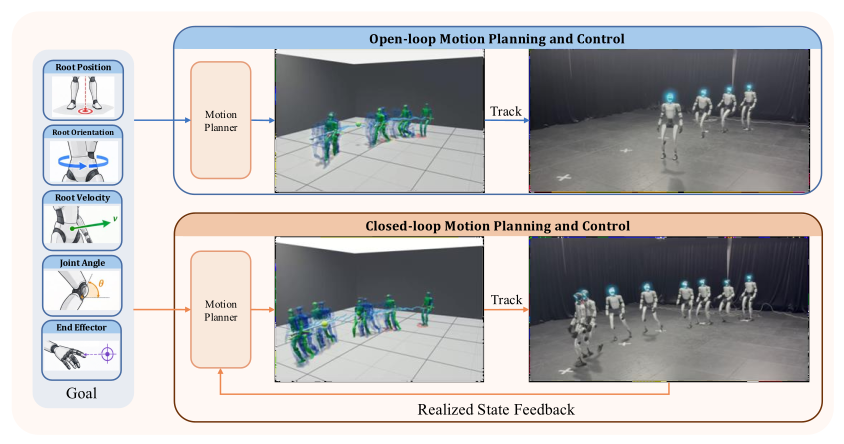
Recent generative models are widely used to provide whole-body motion for humanoid tracking. Current methods combine motion generators with controllers in an open-loop paradigm, which leads to critical issues: tracking errors can accumulate into spatial drift, and the planner cannot adapt to unexpected physical disturbances without feedback from physical execution. However, directly feeding realized states back to the planner in a closed loop can cause discontinuities, resulting in physical jitter and even falls, since such states are out of distribution during training. To bridge this gap, we propose HIPC, a real-time Humanoid Iterative Planning and Control framework that couples a generative model with motion tracking into a unified planning-and-control paradigm. HIPC introduces a goal-conditioned motion planning trained with a canonical motion representation that avoids gimbal-lock singularities under extreme orientations and supports motion generation on diverse geometric and semantic conditions. Then, HIPC adopts two strategies, deviation-decayed recovery and history re-anchoring, to mitigate the out-of-distribution shift caused by realized-state feedback. Finally, HIPC operates a real-time asynchronous planning-and-control system, with latency compensation to reduce temporal mismatch for inference delay. Extensive experiments confirm the effectiveness of HIPC under switching and composition of diverse conditions. Results show that HIPC achieves state-of-the-art goal-reaching accuracy among existing methods while simultaneously demonstrating robustness to physical perturbations and the ability to recover from falls.

1. Goal-Conditioned Tracking

1.1 Individual Goals

#1 Root Position

Goal Distance: 1 m
Goal Distance: 2 m
Goal Distance: 3 m
Goal Height: 0.4 m
Goal Height: 0.6 m
Goal Height: 0.8 m

#2 Root Orientation

Yaw: 90°
Yaw: 180°

#3 Root Velocity

Forward: 0.6 m/s
Forward: 1.0 m/s
Forward: 1.5 m/s
Backward: 1.0 m/s
Left: 1.0 m/s
Right: 1.0 m/s

#4 Joint Configuration

Half Squat
Raise Hand

#5 End-Effector Position

Static Goal
Dynamic Goal

1.2 Composed Goals

Walking
Running
Marching

1.3 Dynamic Goal Switching

Goal Attraction
Dynamic Goal Switching

1.4 Real-World Goal Tracking

Open-Loop
Closed-Loop (HIPC)

2. Robust Tracking & Recovery

2.1 Robustness under Perturbations

2.2 Fall Recovery & Get-Up

3. Comparison Experiments

3.1 Baseline Comparison

3.2 Open-Loop vs. Closed-Loop

Open-Loop
Planning from predicted history
Closed-Loop (HIPC)
Replanning with realized state

4. Scene Navigation

4.1 A*-Guided Maze Navigation

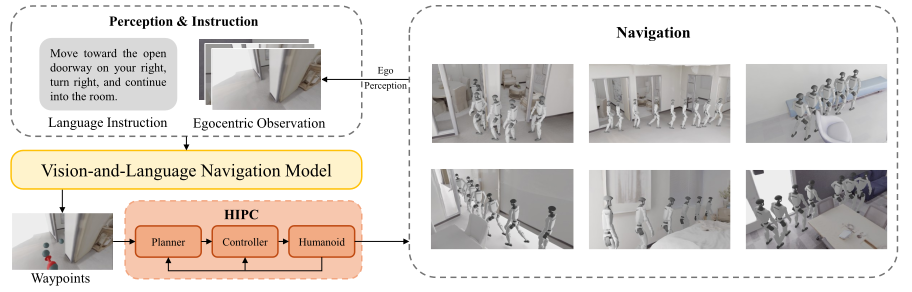
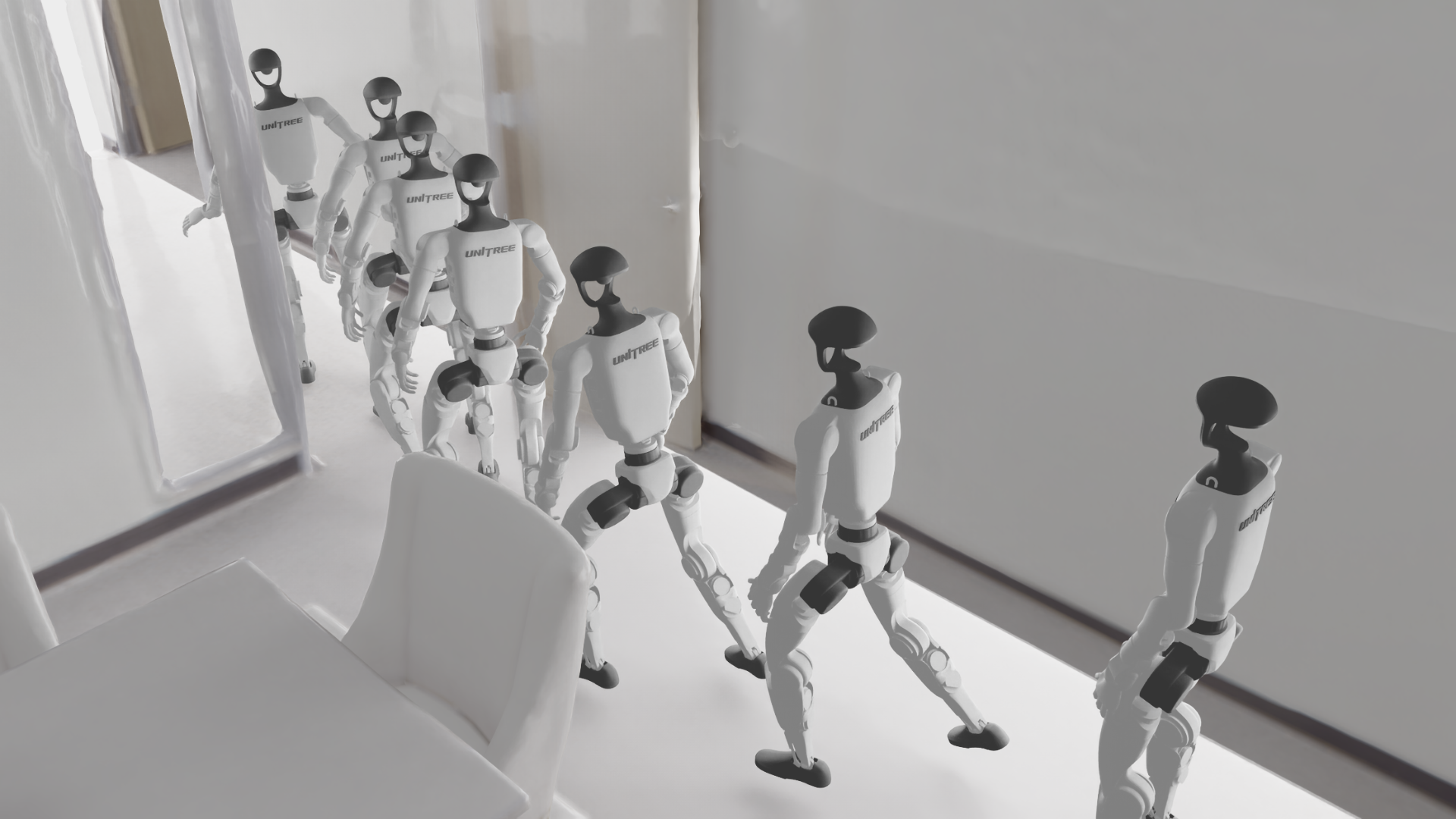
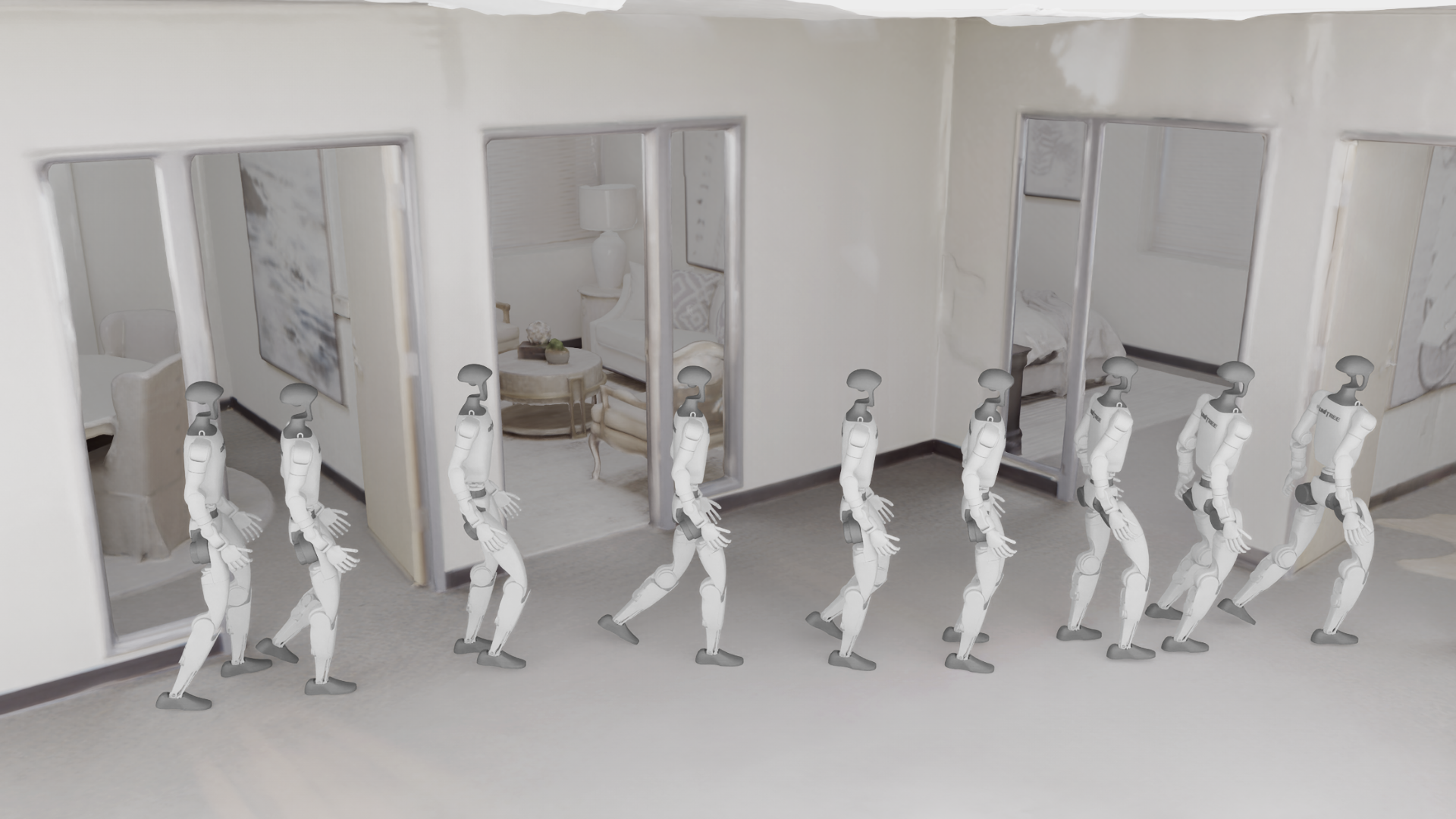
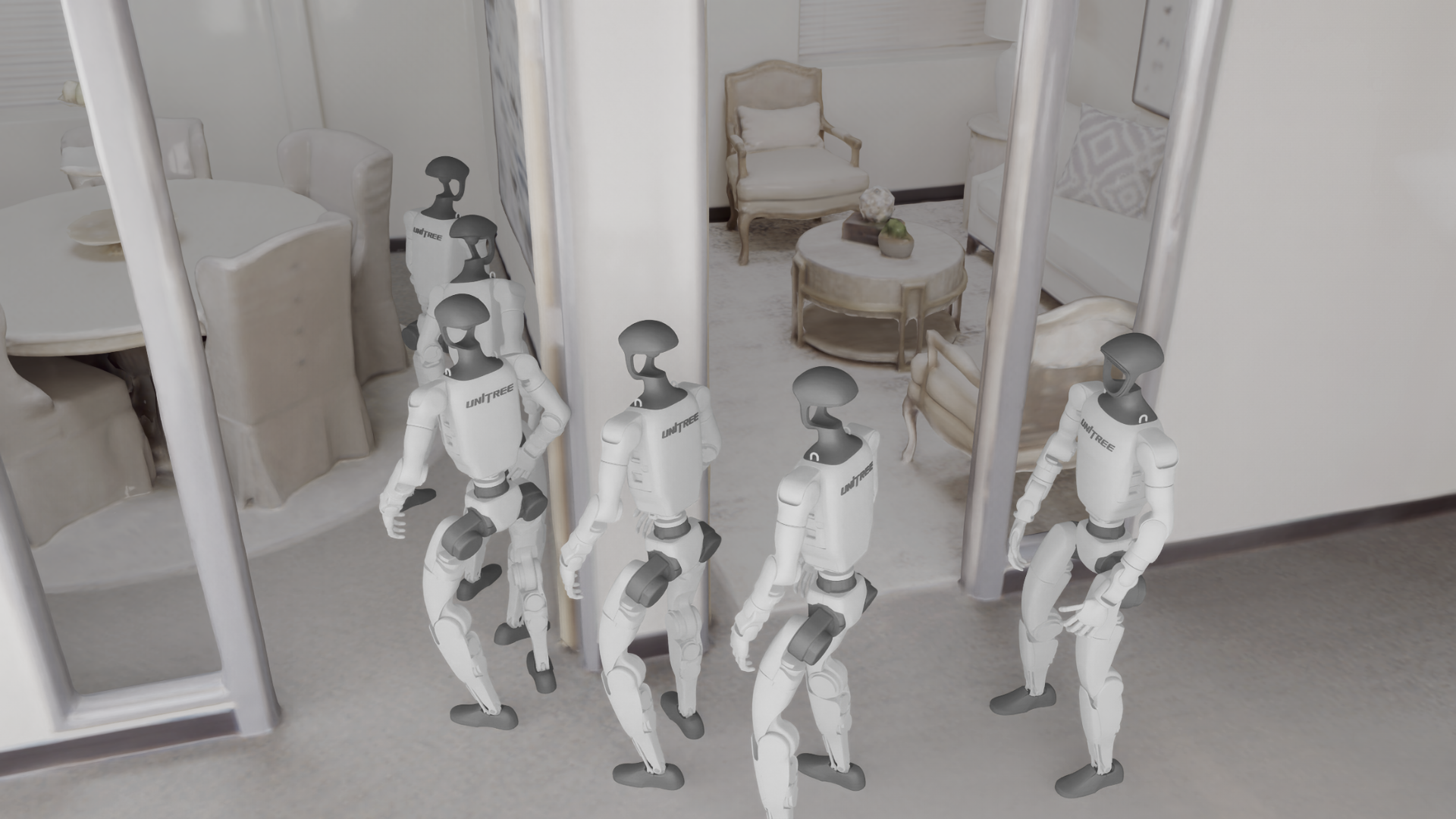
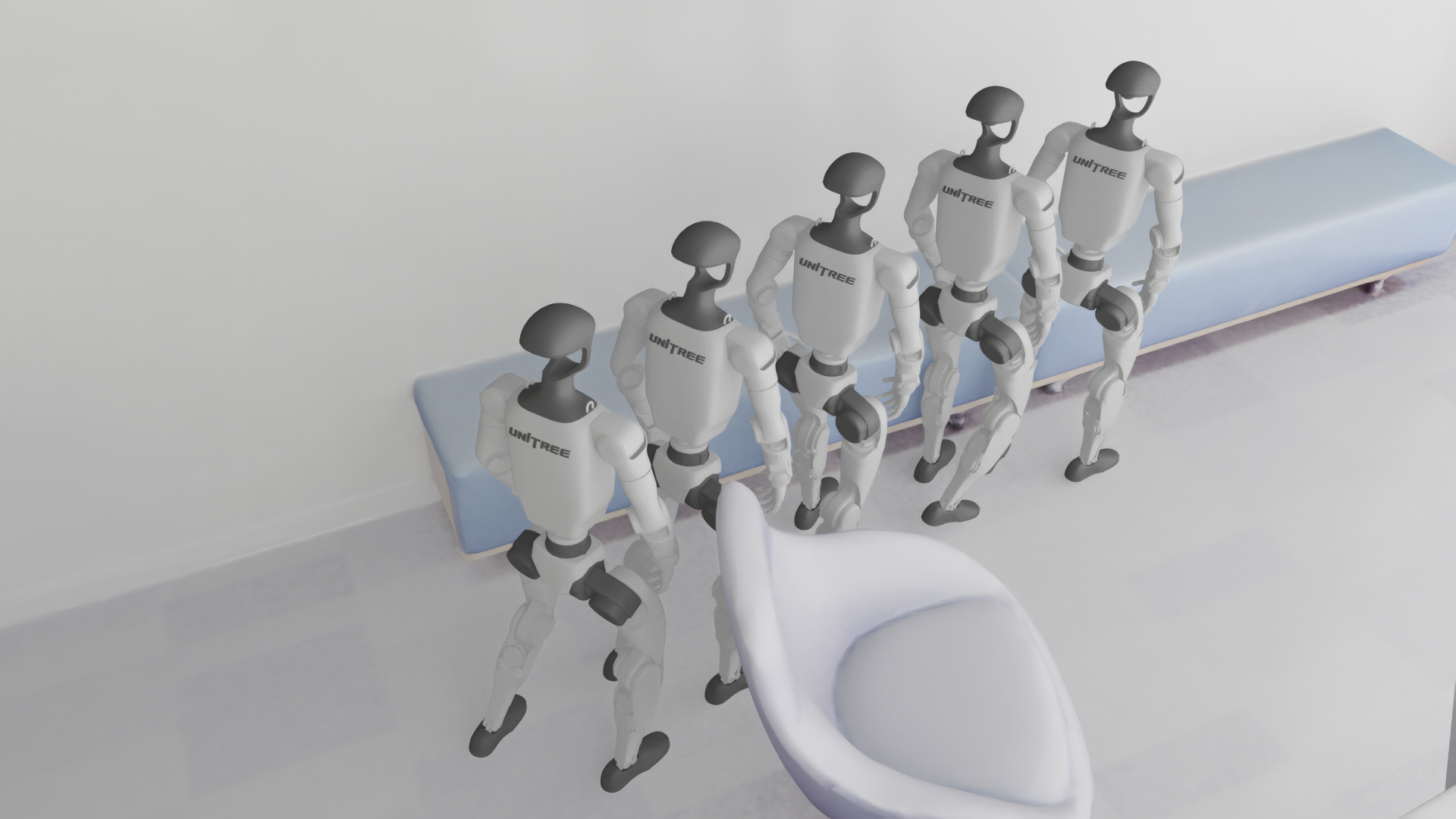
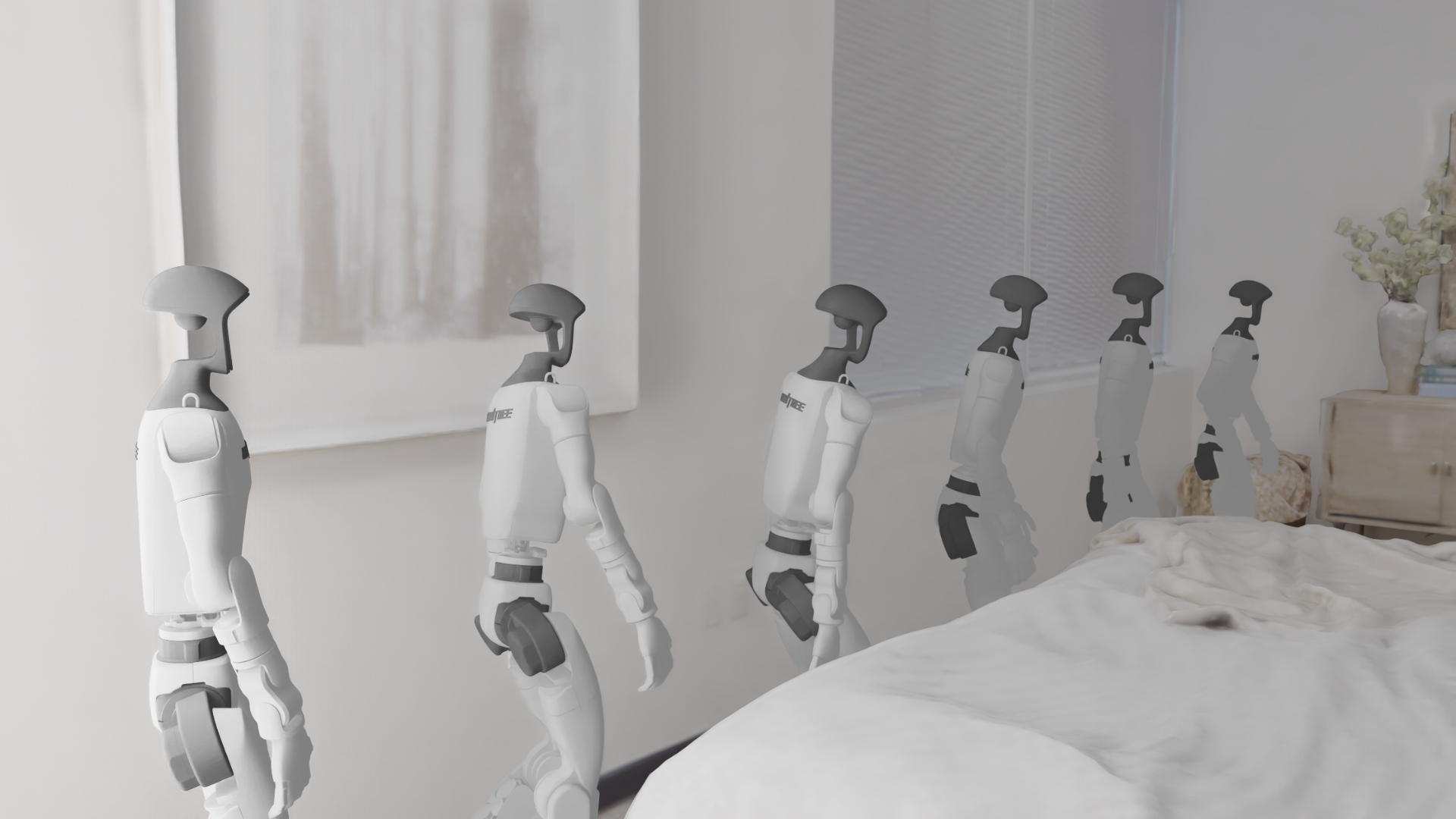
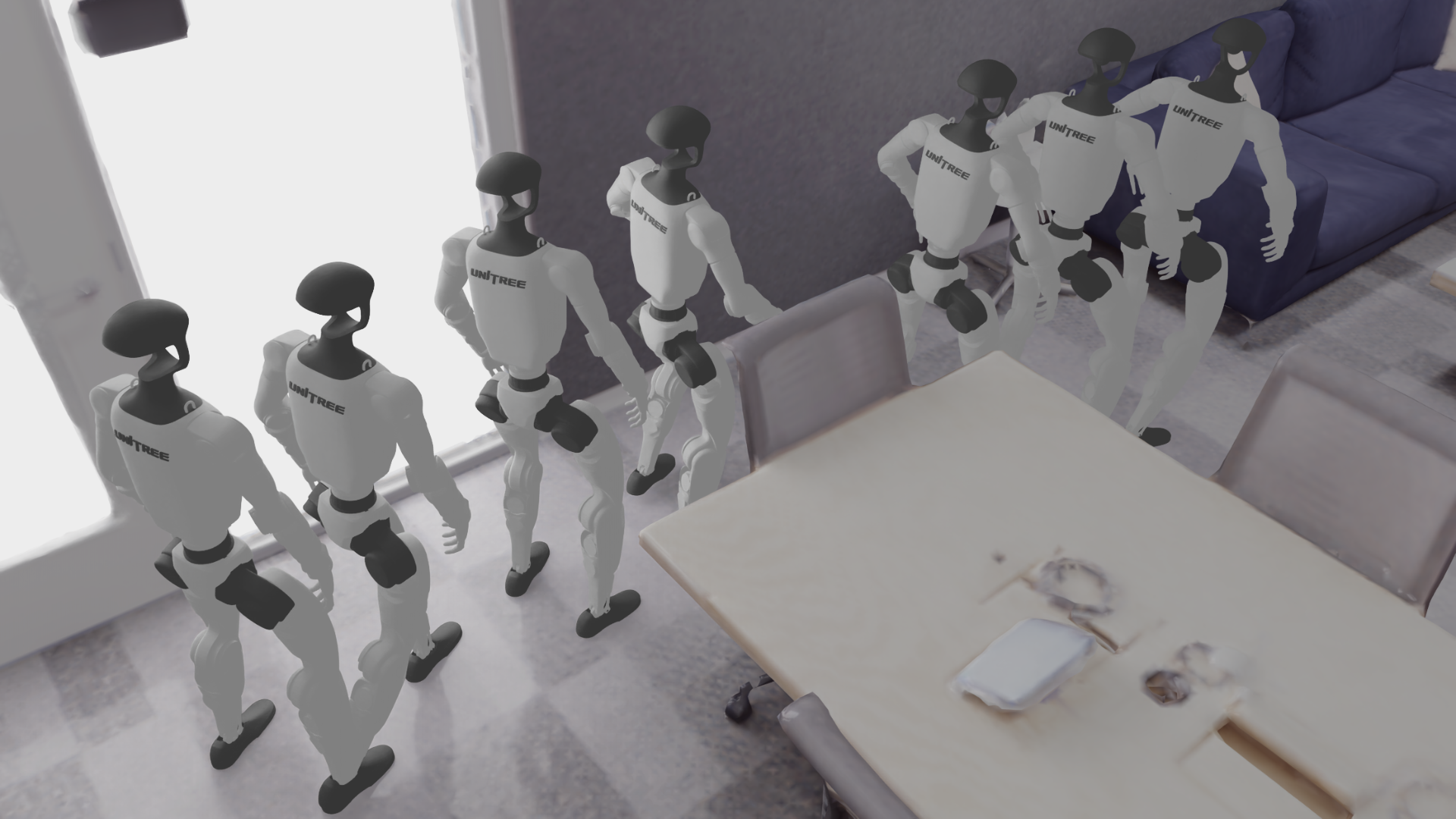
4.2 VLN-Guided Indoor Navigation

Overview of VLN-guided indoor navigation
Scene experiment 1


Scene experiment 2


Scene experiment 3


Scene experiment 4


Scene experiment 5


Scene experiment 6

Conclusion

We presented HIPC, a closed-loop humanoid planning-and-control framework that integrates goal-conditioned generative motion planning with execution-consistent feedback and latency-aware asynchronous control. By closing the loop between motion generation and physical execution while preserving planner–controller modularity, HIPC supports accurate goal reaching, robust perturbation recovery, and recovery from unseen fallen configurations across diverse whole-body tasks.

BibTeX

@article{han2026hipc,
  title = {HIPC: Humanoid Iterative Planning and Control via Goal-Conditioned Motion Closure},
  author = TBD
  year = {2026}
}